War Machine
War Machine is the production cell around Rosie 1400 for welding and other high-throughput processes: an A/B positioner, an integrated sensor suite, control, and a safety envelope, in a 10 ft or 20 ft container format. The operator unloads and loads one side while Rosie works the other, so the arm is not left waiting on part handling. The sensors measure every part before, during, and after the process, and the cell records the evidence.

Scan, weld, index, repeat.
One production cycle on the War Machine cell, drawn live from its CAD model. The mast scanners check fit-up, Rosie 1400 welds both seams, and the turntable turns 180° to swap the bays.
Switch the camera to follow the torch or the loader, circle the cell, or see it from the load end, the rear, or above. Every view runs on the same cycle.
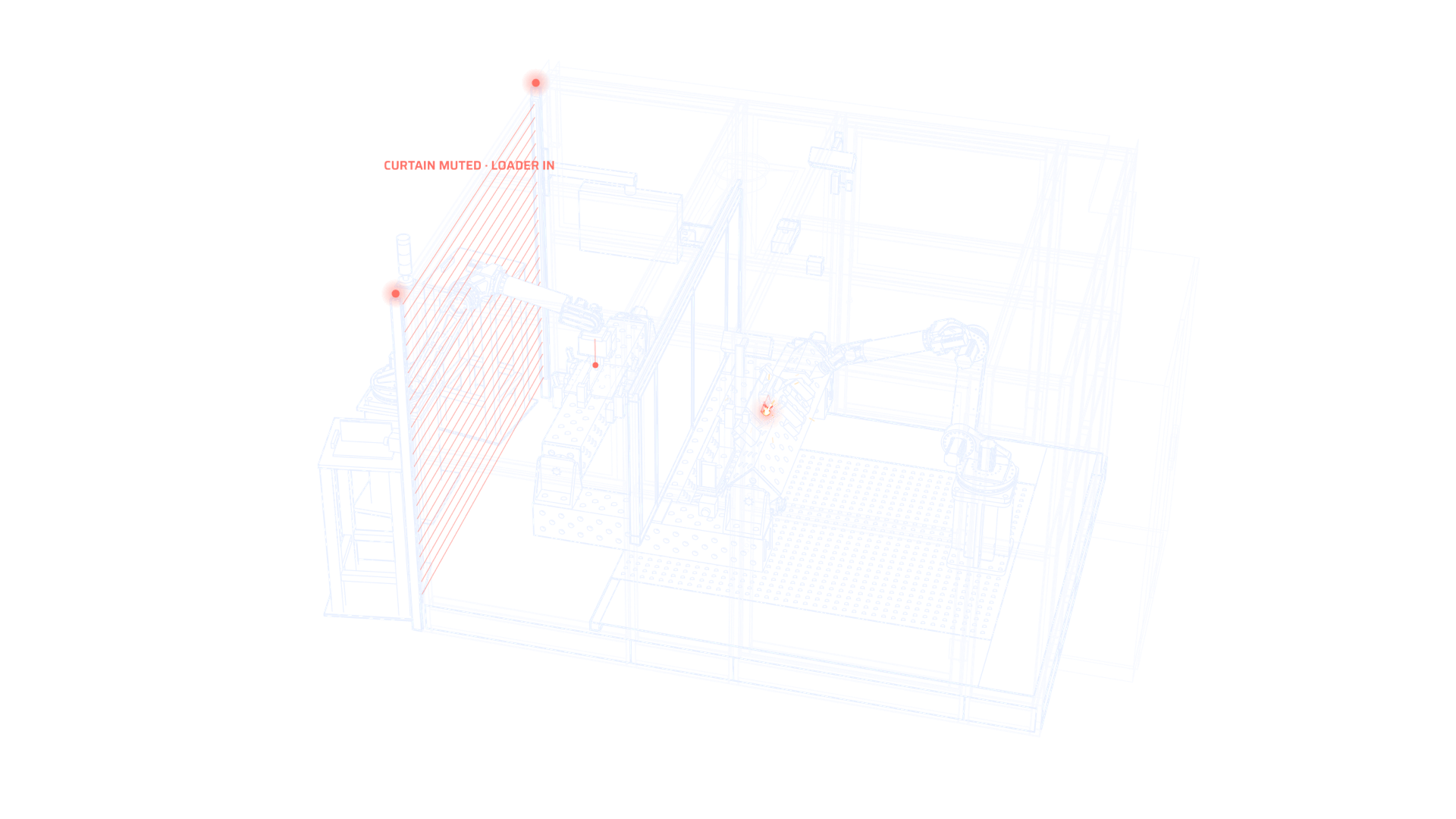
Two bays, one arm, and a sensor suite.
War Machine is the cell around Rosie 1400: the A/B positioner, fixturing, sensor suite, control, safety envelope, and production format.
The robot, the positioner, and the sensors share one machined base and one coordinate system, so a scan taken at one end of the cell is valid for the tool at the other. Research and production run on the same cell and share one data record.
Robot
Rosie 1400, AMR's six-axis robot, with a 1,400 mm reach and the RosieOS controller. Designed, machined, and assembled in the USA. Rosie 1400
Positioner
An H-frame with two fixture bays on a turntable: the operator loads one bay while Rosie works the other. A rotisserie on each bay turns the part to meet the tool, so weld seams present downhand.
Sensor suite
Scanners on the masts measure each part against the CAD model as it comes round to the robot. Sensors on the end-effector measure during the process and inspect the result after it.
Evidence loop
Each part produces a data record. Weld coupons are sectioned, etched, and inspected in the AMR metallurgical lab, and the results inform the next weld, fixture, and procedure.
Cell plan
Six zones on one base
The robot, the positioner, and the sensors share one base and one coordinate system, so a scan taken at one end of the cell is valid for the tool at the other. Hover over or focus a zone for details.
20 ft container · base 2,593 × 1,374 mm · 6,000 lb · 20 kW
Load one side while Rosie works the other.
The H-frame carries two fixture bays on a turntable. While the robot works the part on one bay, the operator unloads the finished part from the other and loads the next. The turntable then turns and the bays swap.
Unloading, loading, and fixturing happen outside the robot's cycle. While the process time on one bay covers the handling time on the other, the arm goes from one part to the next with only the turntable swap between them. Its utilisation is set by process time, not handling time.
On each bay, a rotisserie, the cell's seventh axis, turns the part under the torch. Every seam comes round to a reachable, downhand position, and the arm works in its strongest posture.
- A/B turntable
- Two bays, one robot. One bay faces Rosie 1400 while the other faces the operator, so loading and unloading happen beside the process, not instead of it.
- Rotisserie
- Rolls the part as the torch works, so a circumferential seam welds in the flat position and a fillet opens upward to the torch.
- Moves with the robot
- The positioner and the arm move together, so the part turns to meet the torch through the whole weld.
- Fixture plates
- Two perforated 1,200 mm fixture plates with fixture holes on a 100 mm grid.
- Loading
- The operator unloads and loads the outer bay as standard. As an option, a second Rosie does it from outside the light curtain, as in the cycle drawing at the top of the page.
Welding first, and other processes that suit two bays.
The A/B layout pays off where each part holds the arm for at least as long as it takes to change the part on the other bay, and where the part gains from being turned to meet the tool.
War Machine is built and equipped for welding. With a different end-effector and program, Rosie 1400 can be tooled for other processes on the same positioner and sensor suite. Tooling for these is specified and integrated per application. One arm, many processes
- Welding: TIG, MIG, laser
- The lead process, and the one the cell is equipped for. The next part is fitted up on the other bay while this one is welded, and the rotisserie brings each seam round to the flat position.
- Plasma cutting
- Profiles and holes cut in a fixtured part, with the next part loaded while the current one is cut.
- Deburring and finishing
- A compliant spindle follows the part's edges at a set tool angle, and the positioner turns the part to present each edge to the spindle.
- Inspection scanning
- A laser line profiler sweeps each part and builds a point cloud of its surface, which becomes that part's record while the next part is loaded.
- Dispensing and sealing
- A continuous bead laid around a flange or seam, with the positioner turning the part so the valve can follow the path.
Palletizing and machine tending spend most of their cycle on handling, so they gain little from A/B loading. Rosie 1400 is tooled for them in other layouts.
Measure every part before, during, and after the process.
Stationary scanners on the masts measure each part as it comes round to the robot. Sensors on the end-effector measure as Rosie works and inspect the result. Every measurement goes into that part's record.
Parts, fit-up, and fixturing vary, so the cell works from the measured part rather than the nominal one. The mast scan runs on the robot's side of the positioner while the operator loads the other bay.
Inspection results feed back into the process. Each record informs the next weld, the next fixture, and the next assembly. The sensing hardware is designed and built by AMR.
- Before the process. The mast scanners measure the part and check fit-up and 3D geometry against the CAD model, so the cell works from where the part actually is, and a poor fit-up is found before the arc starts.
- During the process. The sensors on the end-effector measure as Rosie works. When welding, the welding intelligence package, a paid and optional skill, tracks the seam within 0.20 mm and monitors the weld pool, adjusting path, torch, and heat in real time, and detects process faults from arc sound. Welding intelligence
- After the process. Inspect the finished part and verify its geometry against the CAD model, with micron-level measurement.
- Into the record. Keep an evidence trail for each part, for qualification, quality review, procedure development, and machine learning.
Locate the real part
Measuring each part in the cell puts the tool where the part is, not where the drawing says it should be, whether the feature is a weld seam, a cut line, an edge, or a bead path.
Adapt the path
The program follows the measured part. When welding, the welding intelligence package's adaptive control also adjusts torch and heat as the seam changes.
Verify the result
The finished part is measured against the CAD model before it leaves the fixture, so a nonconforming part is found at the cell, not downstream.
Trace every part
Each part leaves with its measurements from before, during, and after the process, so qualification and quality review work from that part's own record.
Specification
The figures needed to specify and site War Machine. Robot figures are on the Rosie 1400 page.
War Machine
- Weld processes
- TIG, MIG, laser
- Laser source
- 2–10 kW fiber laser
- Other processes
- Tooled per application
- Positioner
- H-frame, turntable and A/B rotisserie
- Loading
- Operator (standard), robot loader (option)
- Format
- 10 ft or 20 ft container
- System power
- 20 kW
Cell
- Robot
- Rosie 1400, 6 axes, 1,400 mm reach
- Controller
- RosieOS, handheld pendant
- Sensor suite
- Mast scanners, end-effector sensors
- Cell mass
- 6,000 lb, excluding container
- Common base
- 2,593 × 1,374 mm
- Control cabinet
- Professionally built
Install it beside the work, or ship it to the site.
War Machine goes beside a depot, range, shipyard, supplier, or field-forward team, or onto a factory floor.
The same core system serves defense research, supplier development, and production readiness. We prove the weld or process in our Hawthorne R&D lab before the machine ships.
- 10 ft container
- A deployable automated lab that sits beside an existing depot, range, or research facility. The compact format suits constrained sites and forward teams.
- 20 ft container
- The full cell with welding or process equipment, sensor suite, control, safety envelope, fume handling, and work envelope packaged for transport, with optional onboard diesel power.
- Integrated production node
- A factory-floor version that connects AMR sensing, robot motion, and inspection data to a larger production line.
Bring AMR a part family, a weld or process problem, or a site that needs production capacity.
We reply with what the cell can do for it, what we would need to prove first in Hawthorne, and how the deployment would look on your site.
We'll tell you what Rosie and War Machine can do with it.